|
|
|
|
|
| When continuous monitoring of a toxic gas concentration is not essential but monitoring its concentration at a specific moment or at specified interval is all that is desired, UNIPHOS short term detector tube provides the answer. |
|
|

|
- Provides the simplest way to certify the adequacy of fumigation.
- A single measurement gives the total phosphine dose in ppm hours.
- No Sample- draw pump is required.
- Clear boundary and good colour contrast.
- Average phosphine concentration during fumigation can also be inferred.
- Alphanumeric display with back light
- Can be used for phosphine leak detection in confined spaces.
|
|
|

|
- Consist of a solid carrier material impregnated witt Info (PDF 44 KB)h sensing chemicals sealed in a glass tube with tapered tips.
- When a fixed volume of sample air containing the target gas is drawn through the tube by means of a UNIPHOS Precision Air Sampling Pump, a discolored stain develops.
- Stain length is calibrated to directly read the target gas concentration in ppm, percentage or mg / m 3 on the tube scale.
- Tubes are available for NH 3 , H 2 S, SO 2 , Cl 2 , PH 3 , HCl, HCN, CO, CO 2 , CS 2 , C 6 H 6
|
|
|
|

|
Specially designed pocket size instrument for Personal Protection & Safety from the hazards of combustible and toxic gases.
- Highly stable against zero drift and quick to respond to changes in target gas concentration.
- AContinuously display gas concentration on an LCD display.
- Two user settable alarm set points.
- Available for SO2, O2, CO, NO2, NO, H2S, HCN, HCl, Cl2, H2, NH3, PH3, ETO, Combusitble Gases ( Explosimeter ) and many other gases.
- Average phosphine concentration during fumigation can also be inferred.
- Alphanumeric display with back light
- Can be used for phosphine leak detection in confined spaces.
|
|
|

|
The Uniphos - 395 Breath Alcohol Analyser is a microprocessor based hand-held instrument, which measures the blood alcohol content in a person who has consumed alcohol. It is done by measuring the breath alcohol content & relating it to the blood alcohol content

- MicroAdvanced micro-processor based technology
- Detects breath alcohol level between 0 to 500 mg/100ml of Blood or 0.000 to 0.500 BAC
- Handy, accurate and easy to use
- On-board memory, computer and printer interface
- On-board memory, stores up to 3000 test results along with time and date.

- Computer and printer interface
|
|
|
|

|
The UNIPHOS 251PM-F is a microprocessor based monitor for field determination of fumigation concentration.
- Advanced microprocessor based technology
- Optional user selectable able visual alarm
- User selectable unit of measurement viz. mg/l; Oz/1000 cu.ft or % v/v
- Table top model
- Inbuilt sample draw pump
- Alphanumeric display with back light
- Data logging with a capacity of 500 data storing
- RS-232 interface to a serial printer or PC
- Dual gas for Methyl Bromide & Phosphine monitoring variant
|
|
|
|

|
system. Designed for permanent installation, the unit is able to monitor the presence of combustible gases such as LPG, CNG, LNG etc. in a variety of applications.
- Microprocessor based system with in-built self-test facility & RS 485 digital data communication link.
- Local & an optional Remote Alarm Indicator console provides audio-visual alarm status from all detector heads.
- Relay output for automatic activation of exhaust fan, hooter, solenoid valve etc.
- CMRI / CCOE certified Gas Leak Detector heads continuously monitors the presence of flammable gases.
- Alarm acknowledgement / reset and mute keys on both local and remote consoles.
|
|
|
|

|
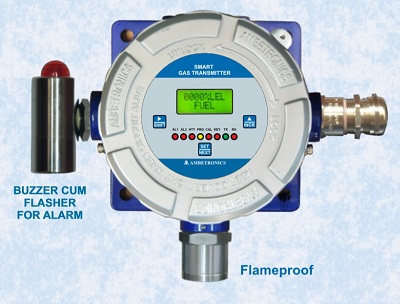
- Housed in explosion proof / weather proof enclosures.
- t houses the sensor and the signal processing circuits.
- The gas concentration is converted into an industry standard 4 - 20 mA current output which can be transmitted over a distance of 1 - 1.5 km to the controller without loss in fidelity.
- These universal transmitters use two wires for communication for all toxic gases and three wires for combustible gases.
- Available for SO2, O2, CO, NO2, NO, H2S, HCN, HCl, Cl2, H2, NH3, PH3, ETO and many other gases.
|
|
|
 |
|
|
|
|
| |
|